|
Making a turntable...
The task of a turntable seems to be simple. At audio frequencies, the arm
should be kept locked above the groove, without any extraneous motion relative
to the cartridge. And the groove should be dragged at a constant angular
speed underneath the stylus. This means that over the whole frequency
band of 10Hz up to 20kHz and beyond, the whole loop made by record,
platter, bearing, (sub)chassis, arm board, tone arm, and cartridge body
should behave in an utterly rigid and non-resonant fashion. Any flexure of the same dimensions as the
microscopic undulations in the groove detracts from sonic fidelity.
At lower-than-audio frequencies, the arm should be made able to freely follow the
groove's warps and excentricities, so as not to damage LP or cartridge, and this
without inducing any spurious signals into the cartridge's generator.
Only when these demands are fulfilled can the stylus trace
the actual information embedded in the record's groove walls.
A simple task, you said?
LP records are warped. LP records vibrate along with the music as the stylus traces the
groove. And LP records tend to move and bend under the pressure of the arm and
cartridge when they are insufficiently supported.
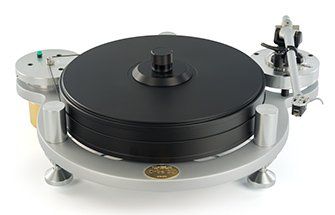
Michell turntables clamp the record to a hard platter. This flattens
out warps, and it also couples the LP tightly to the platter so that
internal resonances can be drained away from the stylus, as if the LP
effectively is of a much higher thickness and rigidity. The Gyro SE and
GyroDec models use a simple clamp to press down the LP record; the Orbe and Orbe SE benefit
from a more
advanced screw-down clamp and a washer that raises
the LP at its center:
under action of the clamp the record's playable area is then very
tightly pressed down onto the flat platter, right to its edges.
We make the platter from a proprietary self-damping
compound of carbon/vinyl -loaded acrylic.
This material closely approaches the mechanical and acoustical properties
of the vinyl record itself, enhancing the coupling between both. Indeed,
at boundaries of materials with like acoustic impedances, transmission of
vibrational energy occurs. Whereas at boundaries of dissimilar materials, be
they LP versus felt, metal, glass, or just air,
only part of the energy is transmitted, the remainder being reflected
back into the album, towards the stylus.
Above measures not only result in a neutral and precise sound, but also in
a very low susceptibility to record blemishes, ticks and pops. This is
one of the reasons why a Michell Engineering turntable not only excels
in the replay
of good LPs, but also pulls the same trick with less than pristine
records. Surely a benefit in this age of scarce fresh vinyl ...
The platter should be supported so that it can revolve
smoothly, without any extraneous vibrations and motion.
This is the job for the main bearing, the very heart of a turntable.
We employ a unique inverted bearing that locates the point of rotation
above the center of gravity of the platter, and exactly at the height
were the drive belt invokes. This makes the platter/bearing a
self-stabilising component that can not be provoked into rocking modes.
The precision bearing has a case-hardened steel shaft that is
secured upright in an oil well, threaded into the subchassis from
below. A massive bronze housing, precision-machined as a pair with the shaft, is
attached to the platter via
the integral record spindle. A thrust ball sits on the flat top of the shaft centralized by an inverted cone in the top of the housing. This housing has a
spiral machined into its inner bore to draw a high quality synthetic oil from
the bath to the top of the bearing shaft as the housing rotates with the platter. A hole is drilled from the top of the shaft down to the oil
well to allow the trapped oil to return to the bottom. This unique oil pumping mechanism results in low friction and wear, and in low rumble and noise. Year after year of operation.
The LP/cartridge/arm trio is to reside on its own 'island'. The
suspension decouples them from the outside world with its motor
noise, footfall, acoustic vibrations, and other potential disturbances.
All of our turntables, except the TecnoDec, suspend the heavy subchassis and platter
from three
extension springs. This is an elegant and self-stabilising solution
as the center of gravity of the floating mass is conveniently put below the
suspension points. Rocking and nodding modes of the subchassis are
hence discouraged, while overall turntable setup is straightforward, and
drift is virtually inexistent.
In addition, the total suspended mass of about eleven kilograms ensures
that any incoupled energy can not result in large displacements.
The spring towers double as the actual turntable supports,
terminated in heavy aluminium cones. The towers are sectioned in two vertical parts, making
a high-pressure point-contact
with a bearing ball. This makes for a true three point
support, which gives the springs and the suspended subchassis a firm
reference to ground.
The floating chassis' task is to keep the bearing and arm board rigidly
in relation to each other. It is a heavy and rigid cast aluminium
component, internally strengthened with beams and ribs. The Orbe and Orbe SE
benefit from an additional layer of DensoDamp
mastic which results in an acoustically inert subchassis with excellent
self-damping properties.
Offering a wide range of custom-made
arm boards, we can keep the
mass, and the mass-distribution, of the subchassis, platter, and arm
a known constant. This translates into a suspended chassis turntable
that works optimally with almost any existing tone arm.
Off-the-shelf boards can be delivered for the following tone arms: Michell, Rega,
SME (both types), Graham, Wilson-benesch, Morch, Origin-Live, and Linn. Others can be
made to order.
The most obvious task of a turntable is to keep the record at a
constant and precise angular speed, without low-rate drift, without
audible wow, and without high-frequency noise components which detract
from the music's delicacy.
The 3.5 kg heavy platter, precision balanced, acts as a large flywheel. The
Orbe's platter is made of three GyroDec platters bonded together to form
one massive slab of acrylic. The GyroDec and Gyro SE employ a single-thickness
acrylic platter, loaded with the gold-plated brass weights which over time
have become Michell's signature. Once up to speed, and aided by the low-friction
bearing, the platter only wants to maintain its motion, and not much extra
input from the motor is needed.
This motor is a very precise, reliable, and low-noise DC motor that has been selected only after extensive listening sessions and reliability tests. The Orbe models use a version of the same motor with a tacho speed control loop back to the supply. With all turntables the motor is a stand-alone unit, housed in a heavy
base of metal (almost 3kg for the Orbe), to elimate vibrational
breakthrough to the turntable. The HR and Orbe Controller NC supplies effectively isolate the motor from the potentially poluted mains network.
Drive is relayed to the platter via a precision-ground soft round-section neoprene
belt, which runs around the platter's circumference. This results in a very high reduction of noise
transfer from the motor.
|