Upgrading the GyroDec

By Ken Kessler, Hi-Fi News & Record Review, August 1994 (reproduced with permission of the editor)

There's now a choice of power supplies to breathe new life into Michell's classic GyroDec turntable

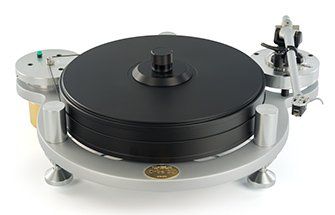
[GyroDec turntable] Rare vinyl having reasserted itself as one of my obsessions, I've been rediscovering the joys of the Michell GyroDec. Eh? Haven't I been using it all along? Well, yes, but familiarity breeds ennui, if not contempt. I'd forgotten how good it was until I returned from a visit to my parents' home, having finally wrested a pile of Mickey Katz records from my father.

Behind the Catskill humour of Schlepping My Baby Back Home, Don't let Schmaltz Get In Your Eyes, and How Much Is That Pickle In The Window lurks big band/kletzmer playing to put some of the most revered of jazz names to shame. (Which explains why a young jazzer named Don Byron is orchestrating an almost single-handed revival.)

So I schlepped the discs back from the USA and fed them through the Moth Record Cleaning Machine even though all were mint. (I owe the pristine condition of my own record collection to my father, for handing down to me his fastidiousness.) Playing them on the GyroDec, I soon learned something I never knew back in '59: that the sound quality of these vintage Capitol LPs is, in a word, awesome.

Prior to my trip home, John Michell had turned up unbidden to collect and service my three year old GyroDec. Upon reflection, I realised that John was just doing what should be considered normal maintenance, no more obsessive than servicing with some regularity a car, a watch, a camera, or any other mechanical device. What warranted a reassessment of the deck, though, were some (admittedly) minor tweaks to the player itself, like the replacement of the aluminium arm board spacers with PVC items, and the appearance of the all-new QC power supply, alias the Gyrocontroller.

Aside from the cleaning up of the 'Dec and the changing of armboard supports, the turntable returned in familiar form. A two-speed player of uncommon beauty, the GyroDec sells for an unconscionably low £*** in basic form, 'basic' meaning clear perspex chassis, aluminium-coloured metal parts, etc. Custom finishes, such as the all-black I have, are available at extra cost, but the purchase which inspired this re-assessment is the all-new power supply. Again in keeping with Michell's charitable nature, the Gyrocontroller QC costs only £***, or £*** if bought with a GyroDec.

Styled to match Michell's line of amplifiers (which, in turn, resemble the shape of the GyroDec), the Gyrocontroller QC supersedes the previous optional power supply. Quartz speed control has been added to ensure 50Hz and 67.5Hz frequencies (for 33.3 and 45rpm respectively) at better than ±0,0025Hz.

The Gyropower's layout, a circular section in front of a vertical slab, works as perfectly for this unit as it does for the power amps because the rear section contains the circuitry while the circular enclosure lends itself quite naturally to house the proprietary Gold Seal toroidal transformer. On aesthetic grounds alone the QC is worth owning; it just looks s-o-o classy: all-black, shiny, finished to the usual Michell standards. Underneath the chassis is the primary power switch, while the top of the rear slab contains the speed selector press button and the two-colour LED which glows green for power-on/33.3rpm and red for 45rpm. Connection to the turntable is via a three-pin connector on a captive lead. The QC even has an adjustable pointy foot at the front.

A primary function of the Gyrocontroller is to provide independence from the mains supply, which is accomplished through two sets of voltage regulators. One set provides ±15V DC to supply the oscillator, logic and filter circuitry with the other delivering ±30V DC to the output amplifiers. A pair of slow-blow 1A serves as protection while a heatsink running the width of the rear panel dissipates energy from the power op-amps and their voltage regulators. The complex circuitry includes a CMOS binary counter and dual D-type flip-flop, an LM324N quad op-amp and power op-amps capable of producing 20W to drive the deck with the aforementioned accuracy.

Back up a bit: I'm only talking here about a power supply, fer Chrissake. This isn't something you sit down and listen to as if it were a 'proper' component…is it? I guess the answer is 'Yes'. So I compared the QC with the simpler unit it replaces, as well as a serious alternative from Tesserac, the single speed TAGS. This device, housed in a black enclosureonly slightly larger than a carton of cancer sticks, provides quartz control, lots of torque, 12W of class AB juice and direct drive to the GyroDec. Priced £*** inc VAT, the TAGS has a tough job to accomplish because it (1) costs a lot more than the QC and (2) it looks like a typically British add-on instead of a piece of sculpture and (3) it's a third-party device rather than one made by the GyroDec's manufacturer. But I duly employed it as well and must now acknowledge the differences a turntable power supply can make.

All three supplies were plugged in and switched on at the same time to ensure equal states of warm-up; I started with the original Michell unit I'd had all along because I first wanted to assess any changes to the deck itself. Allowing for weakness of memory, all I could attribute to the tune-up and the new armboard spacers was a slightly deeper, more solid bottom end; that's it. But I could be mistaken because the sound was familiar. Nothing had changed elsewhere because I fed it into the same system in use before John Michell collected the deck; the arm and cartridge were the same, too. Perhaps the refreshed belts and the change of oil were enough to affect an improvement? No: I wasn't hearing anything new at all. I was hearing the same deck but in optimum condition. Or, as my wife said this morning after retrieving her again Uno from a full service, 'it feels like a new car'.

A quick move to the QC, though, yielded exactly what I did not want to hear: audible, repeatable gains, and in two clearly identifiable areas. I had early on scribbled down some notes which an unsolicited remark from John Michell merely confirmed. As he'll tell anyone who asks, the move from the standard mains-filtered basic power supply to the QC should result in lower wow and reduced motor noise, not that either warranted any concern before. The thing is, these improvements are audibly appearing as quieter background silences, more solid images and greater transparency.

Considering that the QC imparts a different, more thorough form of drive over the basic supply, I can almost accept that the performance must improve. What's shocking is the degree of improvement. While not as great as the leap from one cartridge to another, it easily equals that of changes in cable types. There's one test I can suggest you try if you feel the need to A/B these power supplies.

Quite simply, the most vivid manifestation of occurred when listening to sparse performances known for stellar 3D qualities; turn to audiophile LPs if you must, especially early Sheffield Lab vinyl. The minimalism (even The Drum Record will do) allows you to hear between and around the musician(s). Experience the sense of space, of depth and the silences surrounding the performance. The Tesserac, which matched the QC for silence, couldn't quite the rock-solid, stable-as-Gibraltar image positioning or palpability. Perversely, I must say that some will prefer the Tesserac's lighter touch, so it shouldn't be dismissed. But any GyroDec owners in need of a refresher really should indulge in the embarrassingly arcane pursuit of power supply auditioning. And if you can't hear the gains, then spend the money just saved on a bunch of LPs.

But back to the mono recordings. Having simply stared for many minutes at those Capitol green labels and at elderly vinyl so shiny and pristine as to suggest virginity, I placed them on the Gyro, fitted the ART graphite clamp and listened. All of us have experienced the joy of rediscovering old LPs, discs we put away years before or recently acquired after a scavenge. Better still is finding out how good they sound, especially if, as a child or teenager, you didn't have access to a good system. The Katz LPs are an essential part of my childhood, as well as a link with a near-dead language and culture which constitute 100 percent of my roots; I suppose the best parallel for a typical HFN&RR reader would be Flanders&Swann.

Thanks to the Gyro my listening room got mighty crowded all of a sudden. The impact of a good-sized orchestra, even in mono, came through with crystal clarity. No smearing, no vagueness, edges as crisp as the creases on a soldier's uniform. The 'flip-over-needle' of my old man's record player had inflicted no damage; the trumpets and precussion were as extended and sharp as need be. You could see Katz's tongue in his cheek, smell the herring, taste the knishes. It's the first time a listening session made me feel like I needed an Alka-Seltzer. Is the GyroDec telling me more than I knew before? Is it simply so competent a player that I won't glean more elsewhere?

 I won't lie and say that it's 'the best turntable in the universe'. It isn't. And I'll admit that among the 'wants' on my imaginary list is either an SME model 20 or a Basis Debut Gold, both turntables selling for many times more than the Gyro. Only now I no longer feel compelled to go into hawk. With the coming of the QC , John Michell has moved the GyroDec another notch up de high-end ladder. Quite conclusively, the GyroDec remains one of the biggest bargains in hi-fi, even in basic form. But add in the QC and there is no doubt in my mind that it is the most desirable record deck below £****. Especially because, unlike so much of the opposition, it doesn't look like it was made in a garage.


(Note: in this period Ken Kessler apparently used an SME IV arm and Transfiguration or Lyra cartridge.)


[ Home | Turntables | Preamps | Power amps | Distributors | Picture Gallery | ]