Michell Turntable Gallery

Enjoy these images from the past ... You can click on the pictures for a more detailed view.

Reference Hydraulic

The first Michell-branded turntable, the Hydraulic Reference, derived its name from a hydraulic speed control system: a paddle in a silicone bath was used to selectively slow down the rotational speed of the platter. The Hydraulics shown here are of several colour schemes and have SME 3009 or Fluid tonearms.

Reference Electronic

The Electronic was a simpler version of the Hydraulic, with a more conventional electronic speed control instead of the paddle-in-silicone-fluid. The second Electronic seen here is an extremely rare version with marble plinth.

Prisma

The Prisma was a more up-market model, totally made of thick, transparent acrylic. Initially the LP record was supported by six pods only, as per the Hydraulic, to reduce electrostatic charging of the vinyl. A later version of the Prisma added a glass platter on top, onto which the record was to be clamped.

Three generations of Prismas can be seen here, the oldest with black platter and Fluid arm, the youngest with a Focus uni-pivot arm. Also observe the massive arm board on the modern Prisma, and the general similarity to the later GyroDec.

Focus One and One 'S'

The Focus One was our entry-level turntable in the seventies. It consisted of a simple plinth, rudimentally suspended on three sprung feet. The later 'S' version had an improved drive system and the heavy aluminium platter of the first-generation GyroDec.

Fluid and Focus

In addition to turntables and audio accessories we also manufactured tonearms until the early eighties. Both the Fluid and the Focus were uni-pivot designs, the Focus with a layer-damped arm tube and precision side-weights for azimuth control.

Syncro

The Syncro was an entry-level turntable inspired by the original GyroDec, but with an inverted-pendulum suspension and a glass platter. The latest versions of the Syncro had a more square plinth and dust cover, marking the transition to the Mycro design.

Mycro

Updating the Syncro concept with the MkII GyroDec's black platter and a smaller version of our unique inverted bearing yielded the Mycro, which remained in production until the arrival of the Gyro SE.

CD player prototype

In 1997 we developed a prototype CD player. It was built on the plinth of a Mycro. The photographs show the transport section. The power supply and control electronics were meant to sit to the left of this (in the Mycro's motor position), and the DAC was meant to sit to the right (arm board position).

The CD project was abandoned due to the announcement of DVD-Audio.

Double Prisma

Another curiosity was this twin Prisma: two platters on one plinth, with a shared drive system. Very few were built, mostly for the German market.

GyroDec MkI

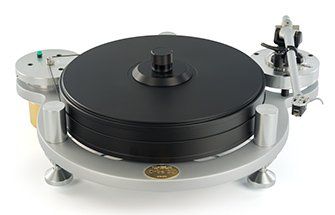
The original GyroDec was born in the early eighties. Contrary to the present version, it used a heavy aluminium platter with a thick rubber mat. Drive was through an AC motor and two belts. Over 30 different types of arm board were available.

Gyropower

The original Papst synchronous motor in the GyroDec could optionally be driven from the Gyropower enhanced supply. The Gyropower was a passive device, with a transformer and extensive RLC filtering of the motor voltage.

GyroDec MkIII

The MkIII was the last incarnation of the GyroDec with plinth-mounted motor. Seen here is a black and bronze sample with Zeta tonearm, photographed at Borehamwood Railway Station.

Gyropower QC

In 1993 the Gyropower was replaced with the much more advanced Gyropower QC. This was a fully-active power supply, synthesising two sine waves with precise phase relationship, which were buffered by two power amplifiers before driving the motor coils. The QC came standard with the Orbe turntable, and was an option for the GyroDec and Gyro SE. The design of the QC's housing was derived off the Michell Alecto MOSFET power amplifiers.

Orbe Millennium Edition

In the year 2000, 50 Orbes were built with gold-plated metal parts. These special edition turntables were sold with SME Series V Gold tonearm, and with the name of their owner engraved in a brass plaque. They also featured a double-thickness plinth and selected bearing components with tighter tolerances.

Twin tonearms

While not a present practice anymore, we used to make some of our models to accept two tonearms. The example here is a black-and-bronze GyroDec with two Rega RB-300s: one with an MM cartridge dedicated to 78rpm records, the other with an MC cartridge for LP replay.

Transrotor

Colleague turntable manufacturer J.Raeke distributes some of our models in Germany under his own brand name Transrotor. Seen here are the Rotary (GyroDec), and the Murano and Black Murano, which are versions of the Syncro and Mycro respectively, modified with the GyroDec motor.

Amplification

In 1989 we launched our own range of electronics: the Iso phonostage and Argo linestage, designed by Tom Evans, and the Alecto MOSFET mono and stereo power amplifiers, conceived by Graham Fowler of Trichord Research. Physical design was by John Michell, carrying the lines of the GyroDec over into the Alecto 'top-hat'.

More amplification ...

The Alecto was later on replaced with its MkII version, while Graham Fowler designed a whole new phonostage and remote-controlled linestage: the Delphini and the Orca. In 2001 Michell Engineering ceased manufacturing audio electronics under its own brand name, and the Delphini/Orca/Alecto line went over in its entirity to Trichord Research.

Many photographs courtesy of Don Sellers, USA.

[ Home | Turntables | Accessories | Press Reviews | Distributors ]